
Know Your Customer, Meet Know Your Agent
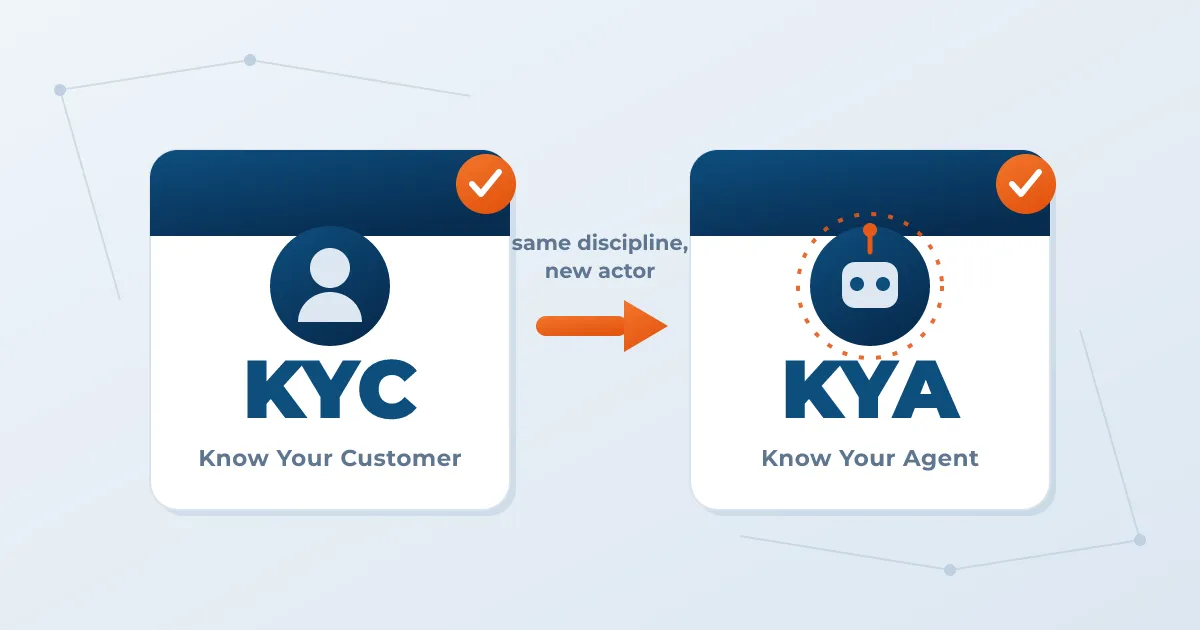
Banks spent thirty years building Know Your Customer - the checks, the evidence, the audit trail that let a stranger open an account without anyone taking it on faith. Now a new kind of stranger is about to arrive at your systems: not a person, but an AI agent, acting on someone’s behalf - booking, buying, filing, negotiating. And the question it raises is the oldest one in trust, wearing new clothes: before you let it act, how do you know it’s actually allowed to?
The market already has a name for the answer. If onboarding a person is Know Your Customer, checking an agent is Know Your Agent (KYA) - and most organisations have nothing in place for it yet.
An API key is not KYA
When an agent connects to your systems today, what does it actually show you? An API key. A login. A vendor’s assurance that “our agent is trustworthy.” None of that answers the questions that matter:
- By what authority is this agent acting - and on whose behalf?
- Did a real person actually approve this action, within these limits?
- Is that authority still valid, or was it revoked an hour ago?
- Is the evidence it presents real, or just asserted?
A credential you can’t independently verify isn’t trust - it’s a promise. KYC stopped running on promises decades ago. KYA can’t start on them.
What you’re really checking
KYC taught us that identity alone is never enough - you verify attributes and authority, not just a name. KYA is the same. Knowing which agent connected tells you nothing about what it may do, for whom, within what limits, and whether that permission still stands.
So a real KYA check verifies four things, in order:
- Identity - a verifiable identity for the agent, cryptographically bound to a real, accountable owner. Not “something connected,” but this agent, tied to that responsible party.
- Mandate - a delegated-authority credential (a digital power of attorney) stating exactly what was approved: spending caps, allowed categories, counterparties, an expiry.
- Validity - a live revocation check, so a mandate switched off moments ago fails now, not at the next batch reconciliation.
- Evidence - a tamper-evident record tracing the action back to the human who authorised it, ready for a dispute or an audit.
The crucial shift: you’re no longer trusting the bot. You’re verifying its credential - and the maths, not the vendor, gives you the answer.
KYA is already buildable - on open standards, worldwide
None of this needs a new proprietary network. The building blocks are the open, international standards behind modern digital-identity wallets: decentralized identifiers and verifiable credentials (SD-JWT VC, OpenID4VP), with status-list revocation for the live validity check. Because they’re open, a credential issued in one system can be verified by another - across vendors, and across borders - with no prior relationship between them. That’s the difference between a trust layer and yet another walled garden.
And this is not a single-region story. Governments well beyond the EU are rolling out digital-identity wallets and converging on the same credential standards - from mobile driver’s licences across US states to national digital-ID programmes in the UK, Australia, Singapore, Japan and beyond. Europe happens to be furthest along on the legal side: eIDAS 2.0 and the EU Digital Identity Wallet explicitly recognise representation - acting on another’s behalf - as something that must be verifiable, which makes the EU an early proving ground. But because KYA rests on global standards rather than any one country’s rules, the authority an agent carries is designed to travel - verifiable by a counterparty in another market as readily as one next door.
KYA runs both ways
Here’s the part that’s easy to miss: KYA is two-sided. The same week you start checking the agents that arrive at your door, your own agents will be showing up at your suppliers, your bank, your partners - anywhere in the world you do business - and they’ll be asked the same four questions. An organisation that can verify inbound agents but can’t give its own agents provable authority is only half-ready.
That’s exactly the shape of the AI Agent Identity trust layer we’re building at Soverio:
- Wallet Gateway lets you accept and cryptographically verify the mandates other organisations’ agents present - KYA through a single integration.
- FastEid Agent issues scoped, revocable power-of-attorney mandates for your own agents, enforces them at a deterministic gate, and gives you a full audit trail - so when someone runs KYA on you, you pass.
The bottom line
Capability is no longer the bottleneck for AI agents - verifiable, bounded, revocable authority is. KYC made it safe to transact with strangers you couldn’t see. Know Your Agent does the same for the software about to transact on their behalf - not just in one market, but across every border its authority can travel. The organisations that build it first won’t just be compliant. They’ll be the ones everyone else’s agents can safely deal with.
Thinking about how you’ll verify AI agents - or prove your own? Let’s talk.